FICCI Legends Series in Mumbai highlights ‘More from Less for More’ as India’s blueprint for affordable excellence, inclusive innovation and global technological leadership
Deep-Tech, AI and Inclusive Innovation Will Shape Viksit Bharat 2047: Dr. R.A. Mashelkar at FICCI Legends Series
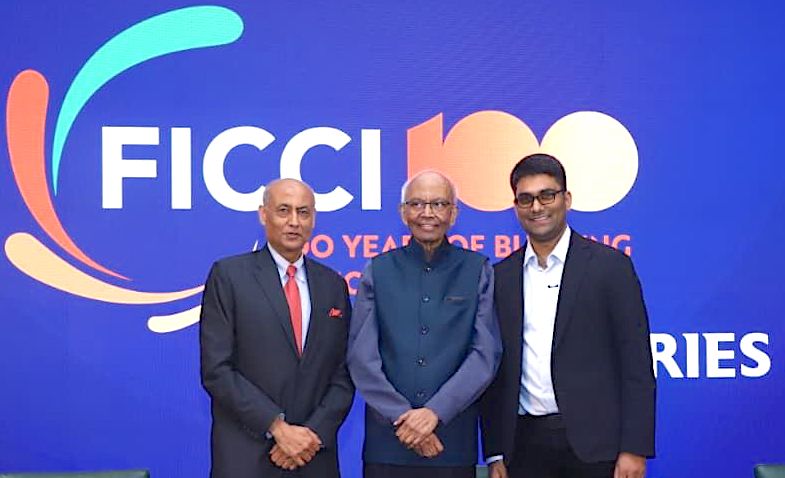
Mumbai, July 14, 2026: Deep-tech innovation, artificial intelligence and inclusive technologies will be the defining pillars of Viksit Bharat 2047, provided India focuses on creating affordable, globally competitive solutions that benefit millions rather than a privileged few, said Padma Vibhushan Dr. Raghunath A. Mashelkar, Fellow of the Royal Society and Former Director General, CSIR, while delivering the FICCI Legends Series lecture on “Winning Through Innovation: Lessons for Industry and Society” in Mumbai.
Addressing an audience of industry leaders, entrepreneurs, policymakers, scientists, researchers and innovators, Dr. Mashelkar said India must transition from being a consumer of global technologies to becoming a creator of world-leading innovations through deep science, artificial intelligence, bold public-private collaboration.
Speaking on his globally acclaimed philosophy “More from Less for More” Dr. Mashelkar said India’s greatest opportunity lies in creating world-class products and technologies that deliver superior performance with fewer resources while making them affordable and accessible to millions of people. He explained that innovation should no longer be measured only by technological sophistication or premium pricing, but by its ability to solve society’s biggest challenges at scale. Excellence, affordability and inclusion, once considered mutually exclusive, must now become the three defining pillars of India’s innovation model.
Dr. Mashelkar said India has repeatedly demonstrated that breakthrough innovations can emerge despite limited resources. From affordable healthcare technologies and digital public infrastructure to AI-enabled diagnostics and deep-tech startups, India has shown that it can produce globally competitive innovations while consuming fewer resources and significantly lowering costs. He highlighted examples such as AI-powered tuberculosis detection through smartphones, affordable breast cancer screening using thermal imaging, digital maternal healthcare platforms and non-invasive anaemia detection technologies, all of which embody the philosophy of creating “More from Less for More.”
Calling upon Indian industry to move beyond merely adopting global technologies, Dr. Mashelkar said the country’s next phase of growth depends on becoming a creator of “Next Practices” rather than simply following global best practices. He pointed to India’s digital transformation, affordable data revolution, deep-tech entrepreneurship and Green Hydrogen initiatives as examples where India has demonstrated the ability to lead global innovation. He also emphasised that Artificial Intelligence should serve as a “co-pilot and never an autopilot,” ensuring that human judgement, ethics and compassion remain at the centre of technological progress.
Dr. Mashelkar stressed that innovation flourishes only when governments actively support high-risk research and disruptive technologies. He urged governments to absorb early-stage technological risks through bold funding, mission-driven programmes and public-private partnerships, enabling startups and researchers to pursue ambitious national challenges. “If India wants to become a developed nation by 2047, we must invest in grand challenges, deep science and technologies that can transform society rather than merely buying the cheapest available solutions,” he said.
Addressing the gathering, Mr. R. V. Kanoria, Past President, FICCI and Chairman & Managing Director, Kanoria Chemicals & Industries Ltd., said, “Innovation is no longer confined to laboratories or research institutions. It is the defining force that will determine India’s economic competitiveness, technological leadership and inclusive growth in the decades ahead. The challenge before industry is not simply to grow bigger, but to create solutions that generate greater value while benefiting a much larger section of society.”
Mr. Kanoria further added, “As FICCI enters its second century, India’s journey must move beyond building industrial capacity towards creating intellectual property, original technologies and globally relevant innovations. Dr. Mashelkar’s philosophy of ‘More from Less for More’ provides a powerful roadmap for achieving sustainable, inclusive and globally competitive growth.”
Mr. Ankit Mehta, Co-Chair, FICCI Drones Committee and Co-founder & CEO, ideaForge, said, “Dr. Mashelkar’s extraordinary journey and his philosophy of ‘More from Less for More’ remind us that the true power of technology lies not in innovation for a privileged few but in creating population-scale solutions that transform millions of lives. As India moves towards Viksit Bharat 2047, stronger collaboration between industry, academia, startups, research institutions and government will be the foundation of the country’s innovation-led future.”
The session, held under the FICCI Legends Series, brought together leading industrialists, policymakers, scientists, entrepreneurs, startup founders, researchers and members of the business community to deliberate on how innovation can drive India’s economic transformation. The discussion reinforced the importance of creating technologies that are globally competitive, environmentally sustainable and socially inclusive, while positioning India as a global leader in affordable excellence and deep-tech innovation.