ABB global survey, 88% of Indian Industrial Businesses Face Monthly Outages, Costing Nearly ₹70 Lakh an Hour
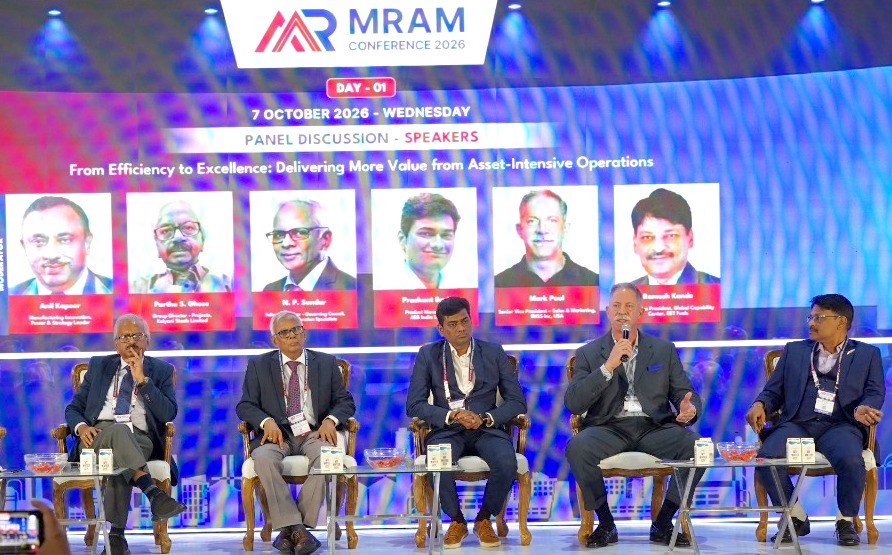
Mumbai, October 7, 2026: India’s maintenance economy could unlock a 1 per cent GDP opportunity by recovering productivity lost to equipment breakdowns, unplanned downtime, inefficient assets and premature replacement, industry leaders said at MRAM 2026 today, citing the growing policy focus on smarter asset management. The NITI Aayog report on AI for Viksit Bharat recommends AI-based predictive maintenance, digital twins, automated substation operations and remote monitoring to build more reliable and resilient infrastructure. At MRAM 2026, industry leaders said moving from reactive, run-to-fail practices to predictive, data-driven and reliability-centred maintenance can improve industrial output, extend asset life, reduce operating costs and strengthen India’s productivity and competitiveness towards Viksit Bharat @2047.
The Government has itself increasingly recognised the importance of asset management. The National Monetisation Pipeline 2.0 report, released by NITI Aayog in 2026, places emphasis on unlocking value from brownfield and greenfield public-sector assets as part of the broader vision of efficient and robust infrastructure for Viksit Bharat @2047.
NITI Aayog has identified AI-based predictive maintenance and asset management as important enablers of India’s economic growth under its “AI for Viksit Bharat” roadmap. Its report estimates that AI could unlock an additional $85–100 billion in value for the manufacturing sector by 2035, driven in part by smarter, more efficient and better-managed industrial assets.
Mr Amit Gupta, Division President, Motion Services, ABB India Ltd., said, “The study’s findings make it abundantly clear that our industry frequently underestimates the genuine consequences of unplanned downtime, and the survey strongly corroborates this reality. It’s paramount that we invest in bolstering reliability, incorporate digitalization to enhance decision-making, and adopt a forward-thinking, outcome-based approach for the long term. This will improve reliability, business reputation, competitivity, cut costs, and provide peace of mind – empowering businesses to focus on their core competence.”.
The issue assumes greater significance as India’s registered manufacturing sector records strong growth. According to the Economic Survey 2025-26, India’s registered manufacturing sector GVA grew 9.59 per cent in 2024-25, while industrial output increased 7.81 per cent and fixed capital grew 10.54 per cent. At the same time, MSMEs account for 35.4 per cent of manufacturing output, 48.58 per cent of exports and 31.1 per cent of GDP, with more than 7.47 crore enterprises employing over 32.82 crore people.
Against this backdrop, Ms. Anitha Raghunath, Founder and Managing Director of Virgo Communications, said India is emerging as a rapidly maturing market for maintenance, reliability and asset management, “India is moving rapidly from a reactive approach to maintenance towards reliability-centred and data-driven asset management. The growth of AI, predictive diagnostics, IIoT and digital twins is enabling industries to identify failures before they occur, improve asset utilisation and extend equipment life. India’s scale of manufacturing and infrastructure investment makes this a significant opportunity, not only for individual companies, but for the country’s productivity and competitiveness.”
The scale of the productivity opportunity is reflected in downtime data. An ABB global survey found that 88 per cent of Indian industrial businesses experienced an unplanned outage at least once a month, compared with 69 per cent globally. The survey estimated the cost to a typical Indian business at nearly Rs 70 lakh per hour, while 19 per cent of Indian respondents continued to rely on run-to-fail maintenance.
Martin Robinson, Founder & CEO, IRISS Group, USA, said, “Better maintenance is a direct driver of productivity and economic growth. It delivers higher uptime, fewer breakdowns, longer asset life, lower operating costs and less waste. For India’s ambition to build a $5 trillion economy, improving asset productivity through smart maintenance, technology and automation can strengthen industrial output, competitiveness and exports, contributing meaningfully to GDP while enabling more responsible growth.”
Globally, the cost of poor maintenance is equally significant. Siemens research estimates that unplanned downtime across the Fortune Global 500 costs companies about US$1.5 trillion annually, equivalent to around 11 per cent of revenues. The data underlines how maintenance is no longer merely an engineering function but a strategic economic issue directly linked to productivity, profitability and competitiveness.
The Indian Asset Performance Management (APM) market is estimated at USD 810.6 million in 2024 and is projected to reach USD 2.25 billion by 2033, representing a CAGR of around 12 per cent. The growth is being driven by the need to reduce unplanned downtime, meet Environment, Health and Safety requirements, improve asset longevity and achieve better returns from capital-intensive assets.
Industry experts at MRAM 2026 said the economic case for maintenance becomes even stronger when viewed across India’s infrastructure ecosystem. Roads, bridges, railways, airports, ports, power plants, water systems, factories and urban infrastructure represent enormous investments, and premature deterioration or avoidable downtime can result in repeated capital expenditure and productivity losses.
The need is particularly acute across manufacturing and heavy engineering, oil and gas and petrochemicals, power and renewable energy, infrastructure and smart cities, railways, aviation and ports, pharmaceuticals and process industries, sectors where asset reliability directly affects production, safety, quality and service continuity.
With manufacturing output continuing to expand, industry leaders said India now needs to move from “build more” to “build, maintain and optimise”, for India’s transition towards a more productive, resilient and globally competitive industrial economy.