
Editor Picks
Dr. Supriya Shah: Sitar harmonies that speak directly to the soul

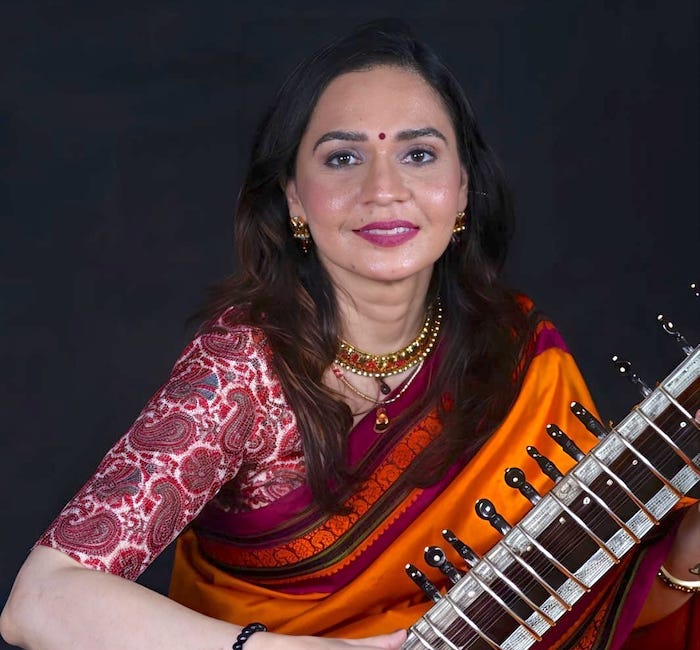
Rooted in the Madhubani-Maihar tradition, Dr. Supriya Shah – the acclaimed sitarist, academic and mentor is carrying Indian classical music forward with a rare balance of tradition, scholarship and contemporary expression.
In an age when music is increasingly measured in seconds, streams and viral trends, she represents something enduring the patience of a raga, the discipline of a tradition and the unmistakable voice of the sitar.
One of the distinguished sitarists of her generation, Dr. Shah belongs to the Madhubani-Maihar Gharana. Her musical identity is firmly rooted in Hindustani classical tradition, yet her approach is not confined by it. Classical raagdari remains at the heart of her music, while her willingness to engage with other musical genres allows the sitar to communicate with audiences well beyond the conventional classical circuit.
A Journey That Began at 13
Supriya Shah’s relationship with music began at the age of 13 under the guidance of Late Pt. Satish Chandra. She subsequently received intensive training in Hindustani classical music and advanced sitar technique from Late Pt. Uma Shankar Mishra, and was also briefly mentored by Grammy Award winner Padma Bhushan Pt. Vishwa Mohan Bhatt.
What followed was not merely a career in performance, but a life built around music—as an artiste, scholar, teacher and cultural ambassador.
Today, Dr. Shah serves as Senior Faculty in the Department of Instrumental Music, Faculty of Performing Arts, Banaras Hindu University (BHU), Varanasi, and is also a graded artiste of All India Radio. Over nearly two decades at BHU, she has trained and mentored numerous students, while extending her teaching internationally through digital classes.
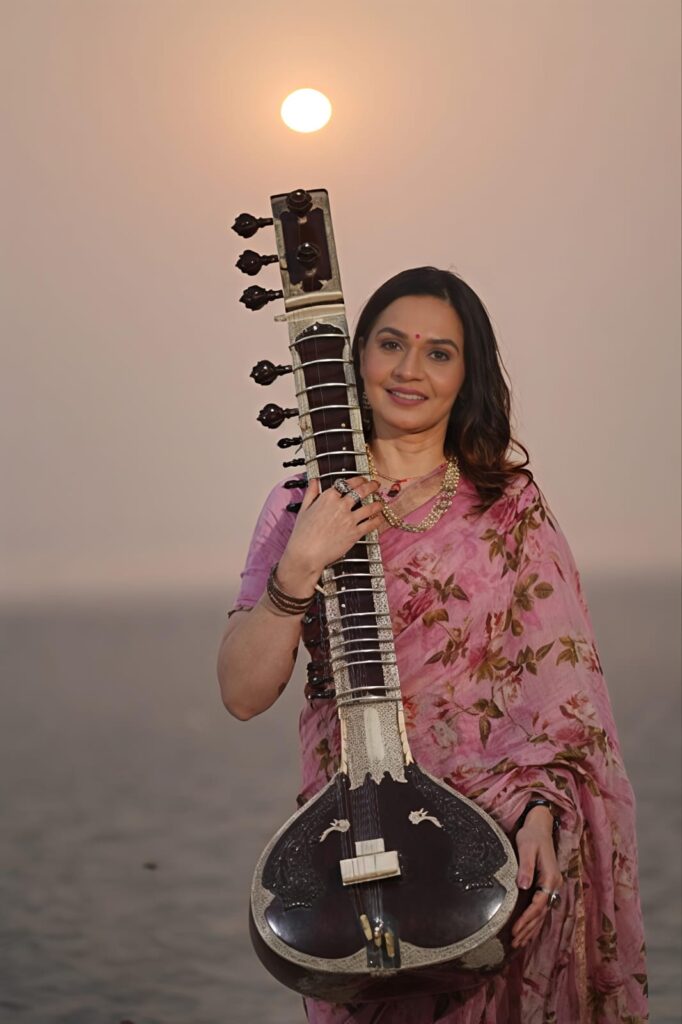 Where Art Meets Scholarship
What distinguishes Dr. Shah is the unusual depth of her academic journey alongside her stage career.
She earned a Ph.D. for her research on the changing scenario of performance practice in instrumental music in the 20th century, with special reference to Hindustani music. She topped the M.Phil programme at the University of Delhi and was a Gold Medallist in M.A. Hindustani Music. Before pursuing music academically, she graduated in Economics (Honours) from Lady Shri Ram College for Women, University of Delhi.
This combination of scholarship and performance gives her music an interesting character: the musician understands not only how a tradition is performed, but also how it has evolved.
From Kashi to the International Stage
Dr. Shah’s sitar has travelled across some of India’s important cultural platforms and beyond.
Her performances include the Sankat Mochan International Music Festival’s centenary celebrations, Sangeet Natak Akademi’s Samyog in New Delhi,Shree Baba Harivallabh Sangeet Sammelan,
RIMPA International Music Festival, Ganga Mahotsav, World Sitar Festival, concerts at the National Centre for the Performing Arts (NCPA), Mumbai, and performances connected with the Krishnamurti Foundation India and several other prestigious cultural institutions.
Her music has also travelled internationally. The Embassy of India in Tokyo featured her solo sitar recitals on Gandhi Jayanti in 2020 and during India’s Independence Day celebrations in 2021.
Her digital concert Anuragini, organised by UK-based Harmoniverse, was showcased through the social platforms of the Nehru Centre in London and The Gandhi Centre in the Netherlands.
She was also invited to conduct sitar masterclasses at the Conservatoire à Rayonnement Régional de La Réunion in 2025.
Recognition Along the Way
Her journey has brought an impressive range of honours.
Among them are the Ravi Koppikar Memorial Award from NCPA, First Prize in the Akashvani Sangeet Pratiyogita, the Laya Jyoti Award, university gold medals and recognition from several cultural organisations. She received the Samskrithi Award 2024–25 in Kerala in recognition of her contribution as a musician and music educator.
In March 2025, her alma mater Seth Anandram Jaipuria School, Kanpur, felicitated her during its Golden Jubilee celebrations as one of its 50 outstanding alumni, also featuring her in a commemorative coffee-table book.
Yet perhaps her more lasting achievement lies beyond trophies and citations.
It is in the students she teaches, the audiences she introduces to the sitar and the bridge she continues to build between India’s classical inheritance and a changing generation.
Tradition That Refuses to Stand Still
Indian classical music survives not simply because traditions are preserved, but because every generation finds musicians capable of making those traditions meaningful again.
Dr. Supriya Shah belongs to that continuum
Her sitar can carry the discipline of the gharana onto a traditional concert stage, travel through digital platforms to listeners thousands of kilometres away, enter a classroom as a subject of serious scholarship, and return again to the intimacy of a raga.
For her, music appears to be less about displaying virtuosity than finding a language deeper than speech.
As Dr. Shah herself expresses it: “Music—where pain is the ingredient for pleasure and sorrow transmutes into joy.”
Perhaps that thought explains the emotional centre of her journey.
The strings of her sitar do not merely preserve an old tradition—they remind a contemporary world why that tradition continues to matter.
• By PARESH B. MEHTA