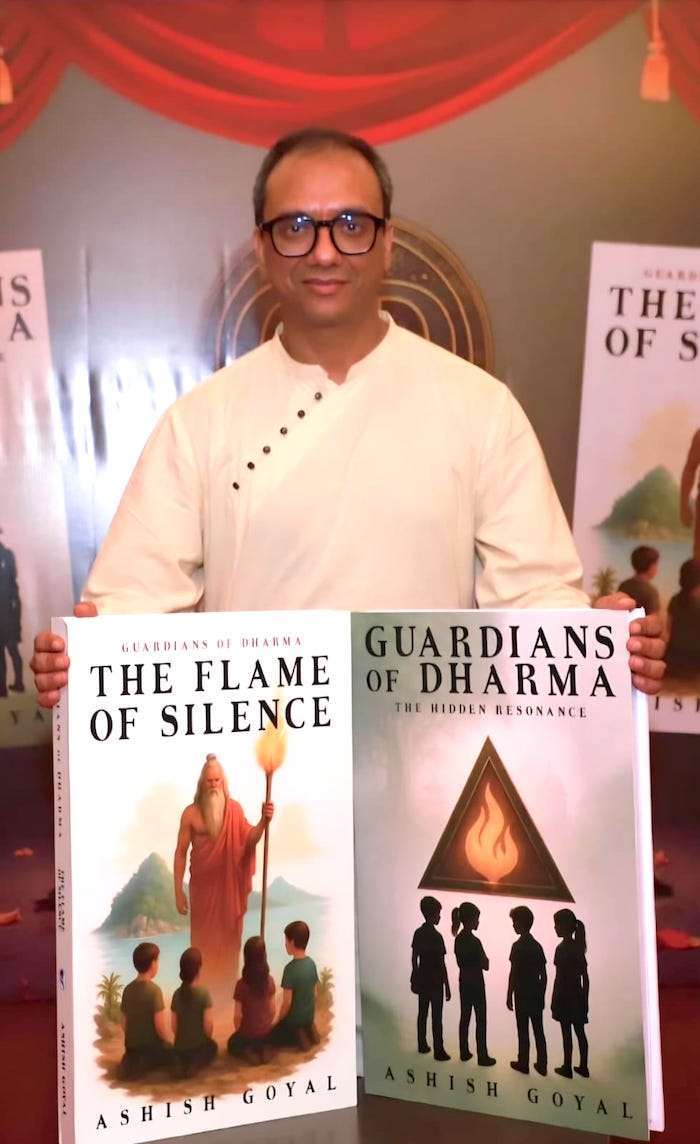
If you pick up Guardians of Dharma, a series by Ashish Goyal, expecting a loud fantasy filled with dramatic battles and sharp turns at every chapter, you may need to adjust your pace. These two books, The Hidden Resonance and The Flame of Silence, move differently. They ask you to sit down, pay attention, and notice what is usually ignored.
Both novels are set in Saraswati Valley Academy, a boarding school that feels familiar from the start. There are classrooms, hostel rooms, private worries, and the small politics of teenage life. Four students stand at the centre of the story. They are not presented as chosen heroes. They are observant, sometimes confused, occasionally impulsive. Their strength lies less in power and more in their willingness to question what they see.
In The Hidden Resonance, the mystery enters quietly. Nothing explodes. Instead, small things feel slightly out of place. A fragment of information does not fit. An object carries a weight that seems larger than it should. The idea that sound and silence may hold meaning runs through the book. The children begin by noticing. Only later do they begin to understand.
What works here is the restraint. The story unfolds step by step. Each discovery leads to another question. The book trusts the reader to keep up. There are philosophical ideas beneath the surface, shaped by Indian thought, yet the novel does not retell mythological episodes. It draws from them in spirit rather than in plot. Silence is not empty. It becomes a space where awareness grows.
The second volume, The Flame of Silence, builds on this foundation. By now, the characters know more. That knowledge brings a different kind of tension. The focus shifts from discovery to responsibility. If you understand something others do not, what are you meant to do with it? Can knowledge remain private, or does it demand action?
The dilemmas become sharper in this book. Questions of intention, technology, and even environmental balance come into view. Yet the tone remains measured. The series does not rush toward spectacle. Instead, it keeps returning to choice. The teenagers argue. They hesitate. They make decisions that carry weight beyond the moment.
One of the more interesting aspects of the series is its treatment of dharma. It is not presented as a rulebook. It is shown as something lived and negotiated. What is right in one situation may not be simple in another. The books allow uncertainty. That gives them a reflective quality.
The prose stays accessible. Conversations between the students feel natural, sometimes light, sometimes serious. The school itself becomes more than a backdrop. Over time, it feels like a quiet witness to everything that unfolds.
There are moments when the themes surface clearly in dialogue, and some readers may wish for quicker movement. Yet the steady pace seems intentional. These books are less about surprise and more about attention. They suggest that awareness develops slowly, and that silence can be as active as sound.
Taken together, The Hidden Resonance and The Flame of Silence form a coming of age story that leans toward thought rather than display. They explore how old philosophical ideas might still matter in a modern school setting without turning the narrative into a lecture.
When I think about the series as a whole, what stays with me is not a single dramatic scene. It is the gradual shift in the four students. They begin as ordinary teenagers. They end as young people who have learned to pause before acting, to question what they assume, and to recognise that knowledge carries responsibility.
In a time when much of myth inspired fiction aims for scale and speed, Guardians of Dharma chooses a quieter path. It asks the reader to listen. And in doing so, it offers something that feels steady and considered rather than loud.